AI‑Driven Experiences at Enterprise Scale: When Intelligence Becomes Infrastructure
AI amplifies what already exists.
This is the single most important principal enterprise leaders need to internalize, and the one most consistently ignored. When experience architecture is weak, AI scales friction. When platform foundations are strong, AI scales differentiation.
Many organizations are past the question of whether or not to deploy or use AI. The real question is whether the systems intelligence is being deployed into are structurally ready to absorb it. Because AI doesn't fix broken journeys. It doesn't unify fragmented platforms. It doesn't manufacture trust where governance is absent. It multiplies whatever it touches, for better or worse.
The enterprises pulling ahead aren't the ones deploying the most AI. They're the ones who designed how intelligence behaves before they deployed it.
Designed Intelligence: The Three-Layer Architecture
At Bounteous, we've developed AI Experience Patterns™ — a methodology and production-ready library that separates intelligent experiences into three distinct, composable layers:
Component UI: What users see. The visual and structural layer of engagement: cards, panels, conversational interfaces, dashboards.
Interaction Pattern: How the system behaves. The logic governing human-system exchange: triggers, inputs, refinement loops, progressive disclosure.
AI Response Design: How intelligence operates. Adaptive reasoning governed by three configurable variables:
- Memory: What the system retains, session-level recall, persistent user history, or collective learning across all users.
- Autonomy: How much agency the system exercises, from assistive (user-initiated) through collaborative (system-suggests, user-confirms) to fully agentic (system acts within guardrails).
- Context: What situational awareness shapes decisions, environmental signals (device, location, time), emotional signals (sentiment, urgency), and operational signals (business rules, compliance requirements, workflow state).
This separation is architectural innovation. It means the same intelligence powering a customer-facing product recommendation can power an internal account planning tool, different Component UI, different Interaction Pattern, identical AI Response Design. It means a pattern deployed for one brand can be translated to another brand's aesthetic in hours rather than weeks. It means designers configure AI behavior through familiar abstractions without requiring engineering intervention for every adjustment.
From Components to Orchestrated Systems
Individual patterns solve individual problems. A Contextual Product Guide eliminates decision fatigue at the point of purchase. A Generative Configuration Tool collapses complex product bundling from a 15-minute decision tree into a 2-minute conversational flow. A Provider Steering System routes patients to in-network care, reducing out-of-network claims and saving measurable dollars per member per year.
But the strategic value inflects when patterns stop operating in isolation and start coordinating across platforms, workflows, and value streams.
This is the progression:
AI Pilots → Isolated intelligence in single journeys. Proves capability, but value stays local.
AI Experience Patterns™ → Reusable, governed intelligent components. Accelerates deployment, ensures consistency, and reduces risk.
Orchestrated AI Systems → Cross-platform coordination where patterns share context, trigger each other, and operate as a coherent intelligent layer across the enterprise.
At the orchestration layer, intelligence becomes infrastructure. A Strategic Account Intelligence pattern detects risk signals on an enterprise account; usage decline, competitor engagement, support escalation. It triggers a Competitive Intelligence module to surface the competitor's latest positioning. A Briefing Intelligence pattern assembles a defensive strategy brief. A Proactive Alerting system notifies the account manager and auto-schedules an executive check-in with the brief pre-loaded.
No human initiated that workflow. The system detected, reasoned, assembled, and acted within designed guardrails, with full observability, at enterprise scale.
The Structural Enablers
Getting from patterns to orchestration requires three things enterprises routinely underinvest in:
Modern Business Platforms. Platforms must provide interoperability, real-time data access, and native AI capabilities that can be configured and governed intentionally. This isn't about replatforming; it's about ensuring the platforms you already operate can serve as intelligent infrastructure, not just content delivery systems.
Intelligent Platform Orchestration. Agents and workflows must coordinate context, content, and decisions across systems, not within a single interface. This is where agentic engineering becomes foundational: designing AI agents that operate with defined autonomy levels, explicit human-in-the-loop governance where stakes warrant it, and clear alignment to measurable business outcomes.
Governed Experience Architecture. AI Experience Patterns™ must operate within guardrails that ensure brand integrity, regulatory compliance, explainability, and accountability. Autonomy without observability creates risk. Personalization without context erodes trust. Automation without governance weakens brand equity.
When these elements align, AI isn't a feature layer — it's the structural capability shaping how value gets delivered.
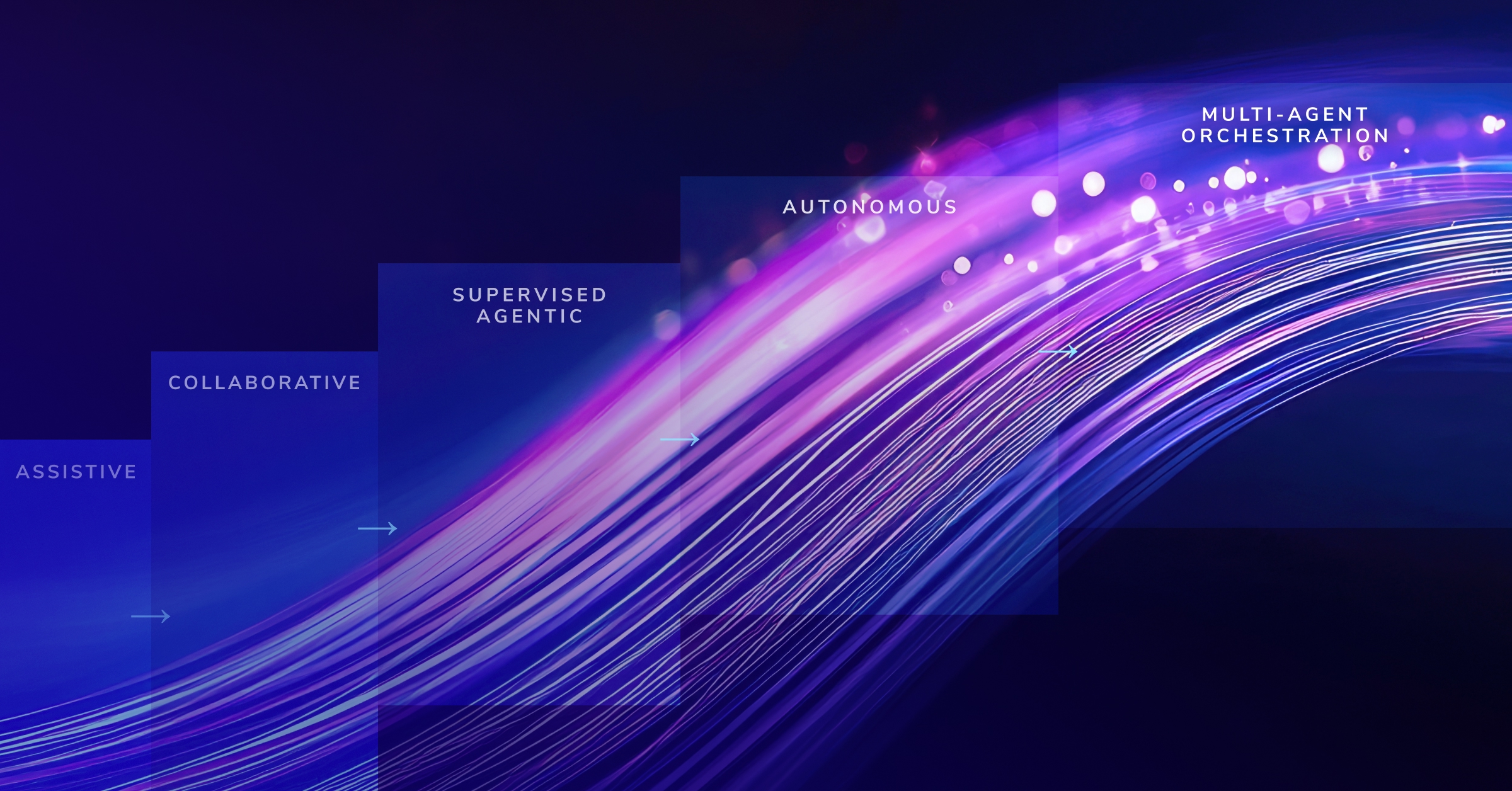
The Autonomy Maturity Model
Not every experience needs to be fully autonomous. The strategic question is: what level of autonomy does each experience warrant, given the stakes involved?
We define five levels:
Assistive: AI waits for explicit user commands. Appropriate for search, filtering, and on-demand analysis.
Collaborative: AI suggests actions; the user confirms. Ideal for product recommendations, content personalization, and guided workflows.
Supervised Agentic: AI acts independently on low-stakes decisions; escalates high-stakes actions for approval. Right for dynamic content optimization, campaign adjustments, and routine operational tasks.
Autonomous Agentic: AI operates continuously within defined guardrails, acting without per-action human approval. Suited for proactive alerting, anomaly detection, and always-on monitoring systems.
Multi-Agent Orchestration: Multiple AI agents coordinate toward complex goals, decomposing tasks, sharing context, and executing in parallel. This is the future state: enterprise process automation where intelligence coordinates across systems, not just within them.
Most organizations should start at Levels 1–3 to build confidence, governance maturity, and organizational trust. The architecture should be designed for Level 5 from day one.
From Adoption to Structural Advantage
The gap between AI adoption and AI advantage is structural.
Adoption asks: Are teams using AI? Advantage asks: Is AI reshaping how we create and deliver value?
When intelligent experience components are integrated into platforms and orchestrated through agentic frameworks, organizations unlock faster time-to-market for new capabilities, hyper-personalization that's governed and contextual rather than invasive and fragile, content supply chains optimized by intelligence rather than managed through manual workflows, and continuous improvement driven by performance telemetry and feedback loops.
AI becomes part of the operating fabric. Not an experiment. Not a pilot. Infrastructure.
The Design Imperative
The future of digital advantage won't belong to the enterprises that adopted AI fastest.
It will belong to those that designed how intelligence behaves — then built the systems to govern, scale, and orchestrate it across every experience that matters.
Design provides the foundation. Platforms provide the scale. Governed autonomy provides the discipline.
The enterprises that treat these as a unified capability, not three separate workstreams, will define the next era of customer and employee experience.
The rest will have pilots.