The Real Impact of AI in Marketing Technology
Artificial Intelligence (AI) continues to reshape how brands understand, engage, and retain customers. Yet for many leaders in marketing, loyalty, and technology, the noise around AI can overshadow the practical value it brings to the customer data and engagement ecosystem. This article breaks down AI in martech into clear concepts, practical applications, and the expanded role of agentic AI across CDP, loyalty, and marketing automation.
Understanding the Core Types of AI in Martech
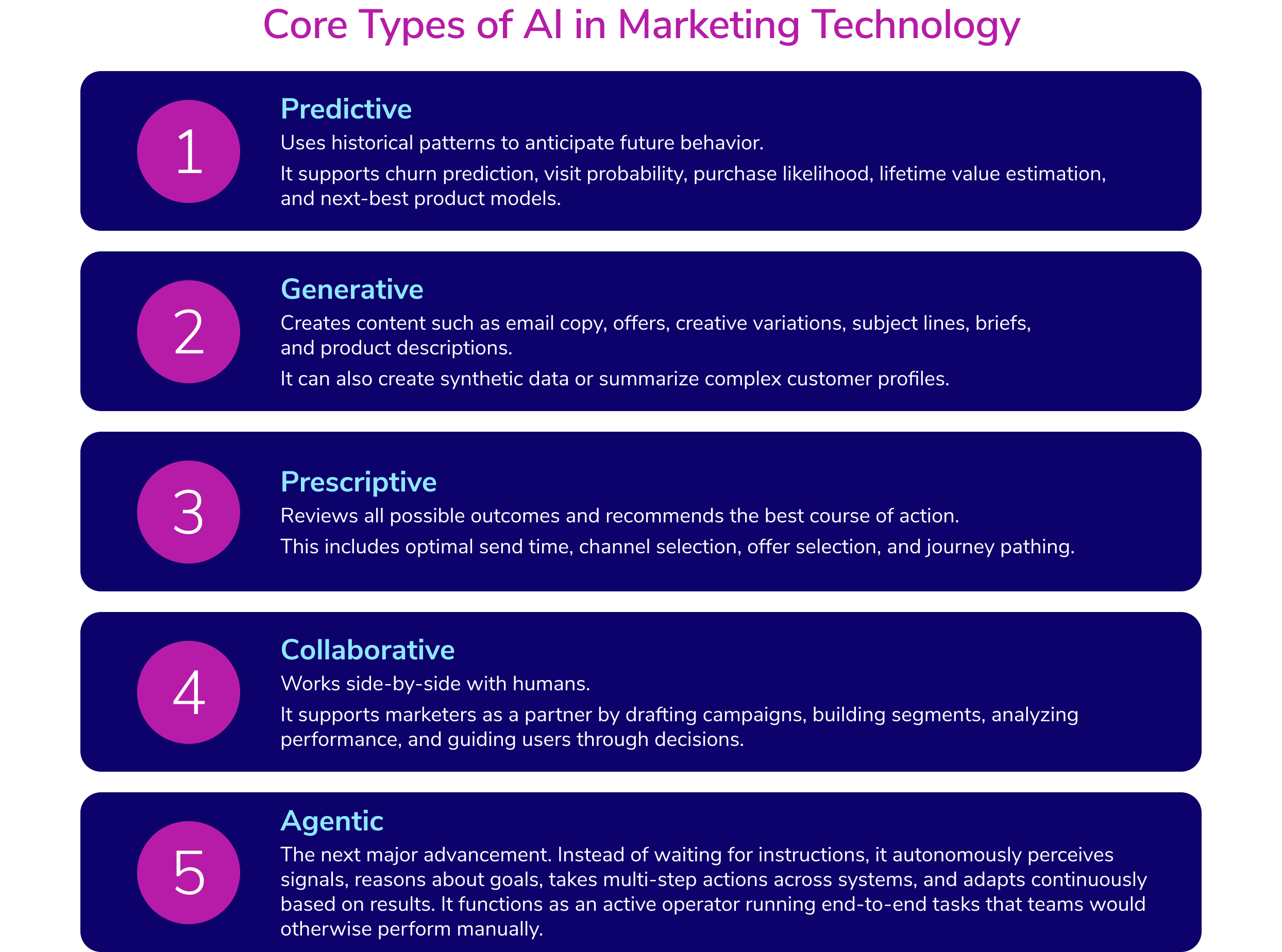
AI is not a single tool. It is a collection of models and capabilities that solve different types of problems. Knowing these categories helps teams understand where AI fits into their operations.
AI Inside the Customer Data Platform
A customer data platform sits at the center of modern engagement as both the intelligence engine and the authoritative source of identity. AI now strengthens this core foundation across every layer of the CDP, elevating how data is resolved, interpreted, activated, and governed.
Within the platform, machine learning improves identity resolution by increasing match accuracy, while automated segment discovery reveals patterns that would otherwise stay hidden. Predictive scoring models estimate churn risk, customer value, likelihood to buy, and visit frequency. Real-time profiles become richer through generative summarization, and adaptive decisioning engines guide activation the moment signals appear. Behind the scenes, data quality agents continuously monitor and correct issues, and agentic workflows autonomously create or retire segments as performance changes.
These capabilities unlock a wide range of practical use cases. Identity graphs become more complete and reliable, fueling deeper personalization. Shifts in customer behavior are detected earlier, allowing teams to respond before trends escalate. Segments can be created, refreshed, and optimized automatically, while data quality is corrected in near real time without manual intervention. AI also recommends audiences that are most likely to engage with specific journeys and can even initiate multi-step actions autonomously through agentic frameworks that do not require repeated configuration.
Across the organization, different teams feel the benefit. Data teams see operational load shrink as the CDP takes on more of the matching, cleansing, and monitoring tasks. Marketing teams gain richer insights and smarter audiences to power creative and channel execution. Loyalty teams receive more accurate lifetime value predictions and behavioral scoring that improve offer design and program decisions. Leadership benefits from a clearer view of customer trends and more accurate forecasting driven by predictive models.
The impact on workload and cost is significant. AI reduces the manual effort required for segmentation, identity correction, and insight generation, relieving analysts and engineers from many repetitive tasks. As agentic AI begins to automate multi-step processes, the platform becomes more self-maintaining and continuously improves, ultimately lowering operational effort while increasing the value generated from customer data.
AI Inside Loyalty Platforms
Loyalty programs are undergoing a major transformation as brands shift from traditional earn-and-burn structures to dynamic systems that deliver personalized value. AI plays a central role in this evolution, strengthening loyalty programs from the moment a guest enrolls to the moment they redeem a reward. Within the loyalty engine, smart offer optimization continuously determines the right balance between motivation and margin. Predictive valuation models estimate the true future cost and appeal of rewards. Customers receive individualized earning and redemption recommendations that align with their behavior and preferences. Tiers become more flexible as dynamic adjustments reflect predicted future value rather than historical activity alone. AI-driven monitoring detects fraud by identifying unusual patterns in real time. Sentiment is interpreted through generative analysis that reads and summarizes member feedback. In more advanced programs, agentic loyalty operations autonomously create new offers, adjust rules, or prevent leakage without waiting for manual intervention.
These capabilities power a wide range of use cases. Offers become more personalized and financially responsible, shifting based on what will motivate a member at any given moment. Interactions during a customer journey can change in real time as AI detects shifting conditions or new signals. Reward abuse is flagged early, giving teams the chance to intervene before losses grow. Tier progression becomes dynamic, reflecting how a member is expected to behave rather than relying solely on past activity. Offer groups can be tuned automatically based on ongoing performance. In mature environments, agentic systems even take action on their own by pausing problematic offers or adding new benefit configurations when the data indicates it is needed.
A broad set of stakeholders benefit from this intelligence. Loyalty strategists gain sharper tools to shape behavior. Offer managers receive more accurate predictions and automated adjustments. Finance teams get stronger cost controls. CRM teams gain deeper targeting precision. Digital product owners see more relevant experiences delivered natively in the app or site. Members themselves feel more recognized and rewarded because the value they receive reflects who they are and what they do.
The operational impact is significant. AI streamlines offer testing, reduces fraud exposure, and makes value predictions more reliable. As agentic systems take on more administrative work, loyalty teams spend less time maintaining rules and more time designing new program moments. The result is a loyalty program that adapts continually without the heavy manual lift traditionally required.
AI Inside Marketing Automation
Marketing automation (MA) has entered a new phase as platforms evolve into always -on engines that orchestrate customer journeys with far greater intelligence. AI sits at the center of this shift, enhancing how campaigns are created, delivered, and refined. Content generation becomes automated across every owned channel, and personalized content blocks are produced at scale without requiring hours of manual build time. Predictive models select the ideal send time for each individual, while real-time orchestration adjusts journey paths as new signals emerge. Creative and subject line testing happens automatically with continuous variation cycles. Performance insights are generated through natural language summaries that help teams understand what is working and what needs to change. In advanced environments, agentic operators can adjust paths, pause nodes, or create entirely new journey variants on their own.
These capabilities unlock a wide set of use cases. Teams can generate full campaigns from a simple prompt, allowing strategy and creative energy to shift away from repetitive setup tasks. Experiments can run automatically without configuration, constantly testing new approaches. Journeys respond in real time as engagement patterns evolve. Content and performance improve continuously thanks to automated learning loops. Dynamic channel routing selects the path most likely to drive engagement for each individual. When journeys underperform or segments decay, agentic systems make adjustments immediately rather than waiting for manual review.
A broad mix of teams benefit from this intelligence. CRM practitioners gain the ability to move faster. Lifecycle marketers see greater personalization with less effort. Creative teams deliver more relevant content without expanding workload. Analytics teams receive clearer insights. Growth managers unlock higher conversion through smarter orchestration. Across all of them, AI accelerates production, eliminates repetitive actions, and improves outcomes.
The impact on workload and cost is substantial. Production cycles shrink significantly, and engagement metrics rise as the system becomes more adaptive. As agentic capabilities take on journey maintenance and optimization, teams spend less time on upkeep and more time on strategy, ensuring that every customer experience remains optimized at all times.
How AI Connects the Entire Martech Ecosystem
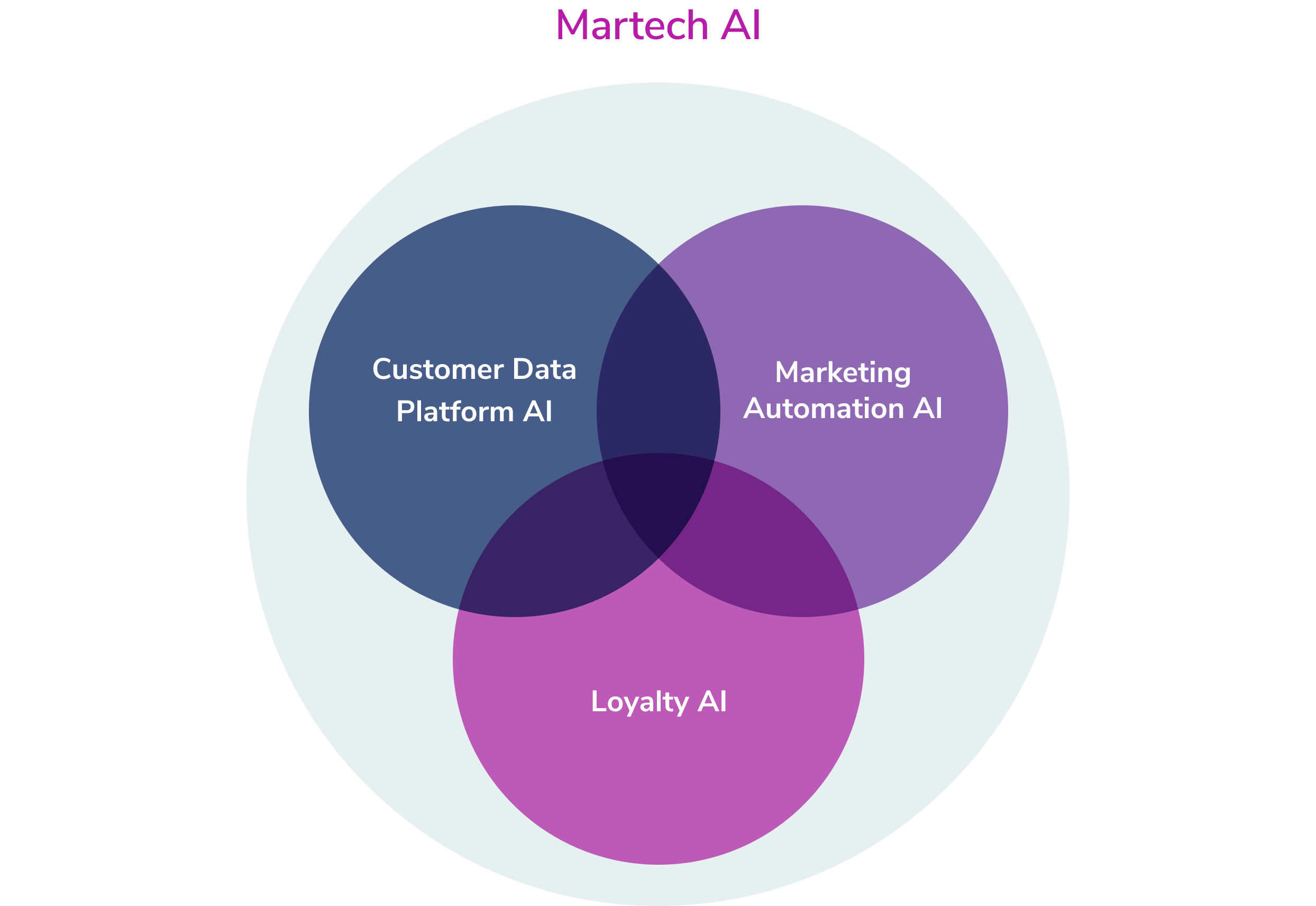
When every system across the marketing and loyalty stack is enhanced with intelligent and agentic layers, the entire ecosystem becomes adaptive, self-optimizing, and far more efficient. Data quality and identity resolution improve continually as AI agents monitor, correct, and enrich customer profiles. Predictions generated in the CDP flow into loyalty systems to shape smarter earning and redemption decisions. Loyalty offers then move directly into marketing automation without the need for manual setup. Customer journeys adapt in real time as CDP signals shift and as loyalty behaviors evolve. Across app, web, and in-store, experiences remain consistent because AI interprets customer intent and aligns interactions across touchpoints. Agentic orchestration closes the operational gaps between systems and automates cross platform workflows that once required extensive human effort.
This progression reflects the rise of two complementary forms of intelligence. Collaborative AI supports teams by guiding decisions, generating content, and helping build experiences more quickly. Agentic AI goes further by executing multi-step tasks, monitoring outcomes, identifying failures, and adapting the system on its own. Together they reshape how marketing, personalization, and loyalty programs operate by allowing platforms to function more like intelligent partners rather than passive tools.
The business impact is substantial. AI accelerates time to market for campaigns and loyalty operations. Operational cost decreases as manual tasks disappear. Personalization becomes smarter and more context-aware while still respecting privacy expectations. Data and identity management become more trustworthy as the system continually maintains itself. Engagement and retention improve through more relevant interactions. Programs across the ecosystem begin to optimize themselves without requiring constant intervention.
Agentic AI elevates this value even further by enabling the martech environment to operate with a degree of autonomy and intelligence that has never existed before. The result is an ecosystem that moves faster, learns continuously, and delivers stronger outcomes for both the business and consumers.
News & Insights
Featured Perspectives