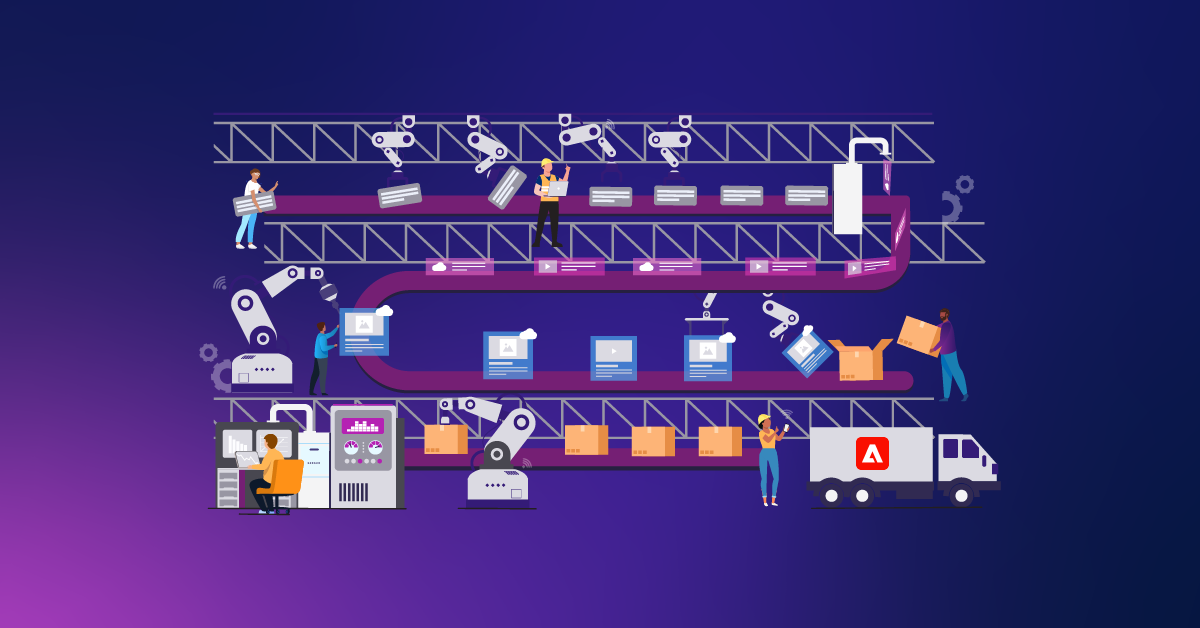
Building the Agent‑First Content Supply Chain
The Content Supply Chain connects the full lifecycle of a campaign, from initial concept through creation, approval, deployment, and performance analytics. When it works, content moves effectively from idea to audience. When it doesn’t, teams get stuck in process, and strong ideas lose momentum.
The foundations of a well-organized Content Supply Chain, powered by Adobe’s ecosystem, are well established. Since then, the landscape has shifted dramatically. AI agents are actively reshaping how campaigns are ideated, built, and optimized.
The Manual Content Supply Chain
Most organizations still operate within a structured, human-driven workflow that takes a campaign from idea to deployment. This model provides consistency and governance, and it remains the baseline for scaling content operations.
Campaign Inception and Intake
Campaigns begin with alignment. Marketing teams define a new concept, validate it, and move into Adobe Workfront through an intake process. Once approved, Workfront Fusion creates a new project based on predefined templates, ensuring consistency across timelines, roles, and deliverables. This structure eliminates manual set up and makes execution repeatable.
Creative Production and Asset Reuse
With the project in place, designers and copywriters work in parallel, often using AI-assisted tools within Adobe Creative Cloud. The workflow is designed for reuse. Teams can pull from the Adobe Digital Asset Management (DAM) system directly, which improves efficiency and maintains brand consistency.
Review, Approval, and Asset Distribution
Once individual pieces of content are ready, they move through review, validation, and approval workflows for quality and brand adherence. Everything that is approved is stored in the Adobe DAM and distributed through Content Hub, making approved assets accessible across teams. This step is what supports scalability because without centralized, reusable assets, content velocity breaks down as demand increases. With assets approved and stored, the campaign is ready to move.
Campaign Deployment
Approved content is then pushed to the campaign tool of choice. Whether that is Adobe Journey Optimizer for email campaigns, SMS platforms, paid media, or landing pages, the same workflow applies. This modularity allows organizations to scale across channels without rebuilding processes each time.
Metadata
Throughout the entire process, metadata connects everything. This includes target audience, color palette, key performance indicators (KPIs), intended customer reactions, desired outcomes such as click-through rates or product purchases. All this information should travel with the campaign from inception through deployment. When metadata is structured and consistent, it enables more meaningful analysis later. Without it, teams are left interpreting disconnected data.
Analytics and the Feedback Loop
After deployment, campaign data flows into Adobe Experience Platform and Customer Journey Analytics to provide insight into performance. Those insights often remain siloed or underutilized. This is where the feedback loop often stalls. Teams may execute campaigns well, but struggle to turn performance data into learning.
Bounteous addresses this with AI-powered tools that centralize campaign data and build institutional memory over time. Teams can interact with data using natural language, uncovering insights faster and applying them more consistently across campaigns.
The Shift to an Agent-First Model
The manual model described above isn’t going away. It is the foundation the agentic model builds on, introducing AI agents at every step where they can accelerate work, improve quality, or enable entirely new capabilities.
The key shift starts at ideation. A Bounteous marketing agent generates campaign concepts based on historical data, audience behavior, and performance trends. Teams review and refine ideas instead of starting from zero. This removes a common bottleneck and allows ideation to scale without increasing effort.
Campaign Creation and Prioritization
The agent generates campaigns and evaluates them. Each campaign concept is scored against a configurable rubric drawn from the organization’s own performance history, audience fit, brand guidelines, and strategic goals.
Campaigns that score near 100% are prioritized for immediate review and production. Those that score lower may still be surfaced but flagged for human consideration as candidates for smaller-scale or experimental testing. This means the pipeline always balances proven approaches alongside creative exploration that can uncover new opportunities.
Budget Impact
Budget intelligence is integrated into the same loop. Workfront and Workfront Planning handle the underlying budget tracking, but the agentic layer is given information about how campaigns are performing relative to their cost and the organization’s broader goals. This gives the agent and the humans reviewing the output a real measure of value taking into account both creative resonance and return on investment. Over time, this informs which types of campaigns are worth funding at scale and which are better suited for limited testing.
QA and Compliance
Quality assurance and compliance aren’t a single gate at the end of the process. They’re configurable checkpoints that can be placed anywhere in the pipeline, and the right configuration will look different for every organization.
Automated checks can run at multiple stages:
- Immediately after campaign ideation to catch brand or strategic misalignment before production work begins
- After content is created and reviewed by design and copy teams
- After campaign materials are finalized and ready for activation
- Across live environments on an ongoing basis
These checks can cover brand compliance, contextual relevance, link validation, accessibility standards, and any other criteria the organization chooses to codify.
Human-in-the-loop review fits into the same framework. Legal review, sign-off on sensitive materials, or approvals required for regulated industries can be inserted at exactly the right points in the workflow. Whether a given checkpoint is automated, human, or a hybrid is entirely up to the organization.
Content creation follows a similar pattern. Agents generate initial assets by pulling from approved content in the Adobe DAM and aligning with brand standards. Designers and copywriters refine and elevate that work. Their role shifts from production to quality and differentiation, which improves both speed and output. This distinction matters for scalability. Traditionally, creating more content requires more people. With an agent-assisted model, teams can increase output without a proportional increase in resources.
Execution also becomes more dynamic. Agents work alongside tools like Adobe Journey Optimizer to configure targeting, journeys, and delivery. Human oversight remains in place for brand and legal approval, but much of the operational work is streamlined.
The agentic model truly diverges from the manual approach in this feedback loop. In a manual workflow, the feedback loop from analytics to ideation requires human initiative. Someone has to look at the dashboards, interpret the data, and bring those insights into the next brainstorm.
In the agent-first model, this loop is automatic. Agents monitor performance, update insights, and feed those learnings directly into the next set of campaign ideas or executive dashboards. Every new campaign concept that the marketing agent stages is built on data from every campaign that came before it.
The result is a system that improves over time without requiring manual intervention at every step.
What Scales and What Stays the Same
As organizations adopt an agent-first approach, certain principles remain constant. Strong intake processes, structured workflows, and clear approval gates are still required. Metadata must remain consistent. Approved assets must be reusable and accessible. What changes is how those systems operate at scale.
As volume increases, agents help manage that complexity that would otherwise slow teams down. Campaigns move faster, insights are applied more consistently, and teams spend more time on strategic decisions and less on coordination.
The agentic model repositions humans in the process, shifting them toward higher-value roles. Marketers can focus on direction and prioritization. Creatives can focus on refinement and storytelling. Leadership gains visibility without needing to ask for it.
The path from a manual Content Supply Chain to an agent-first model does not need to happen all at once. It starts with getting the fundamentals right, including structured intake, reusable templates, a well-organized DAM, and clear governance.
From there, organizations can layer in AI capabilities incrementally. Start with campaign analytics and insight generation. Then layer in agent-assisted ideation and expand into content creation and execution. Each step builds on the last and delivers value independently. The Content Supply Chain has always been about connecting ideas to outcomes. With an agent-first approach, that connection becomes faster, more scalable, and stronger with every campaign.
News & Insights
Featured Perspectives