Fixing AEM Content Promotion: From Manual Workflows to Scalable Authoring
Across Adobe Experience Manager (AEM) programs, the same authoring challenge keeps showing up. Content is reviewed and approved in a lower environment, but moving that approved content into production still relies on a manual handoff. Authors and stakeholders want to validate real content in staging, yet the final step to production often happens outside the authoring experience, creating a disconnect between approval and release.
Teams usually bridge that gap with spreadsheets, runbooks, support tickets, admin scripts, or developer-assisted content moves. These approaches can work in the short term. They rarely scale, and over time, introduce friction into what should be a predictable, governed workflow.
The Authoring Problem That Keeps Coming Back
Many AEM implementations lack a simple, native workflow for promoting Content Fragments between environments with the right level of visibility, guardrails, and dependency awareness.
The issues that follow are familiar. Authors struggle to identify exactly what needs to move, especially when referenced fragments and assets are easy to miss. New fragments require repeated coordination across authoring, QA, and development teams, turning even small launches into manual synchronization exercises. This slows teams down in ways that are often underestimated. Authors lose momentum as they wait for support. Developers get pulled into tasks that don’t require engineering judgment, and QA teams become part of the content handoff process when their focus should be validation.
If moving approved content still depends on ticket-driven coordination or developer intervention, the platform isn’t operating as intended. What should be a governed authoring action becomes a recurring delivery bottleneck.
Why Headless Teams Feel It More
Headless AEM raises the stakes because preview confidence is critical. Stakeholders often need to review real content in a staging environment before it reaches production, especially for launches, seasonal updates, and high-visibility experiences like homepages.
Once content is approved, the gap between "ready in staging" and "live in production" remains. Authors can’t always move content independently, which often pulls developers into non-development tasks and brings QA teams into additional handoffs. As a result, releases slow down because the final promotion step still requires manual coordination. That’s a signal that the operating model hasn’t caught up to the platform. As organizations invest in headless architecture and composable experiences, they also need workflows that support independence, speed, and governance at scale. Without that evolution, teams end up recreating the same manual processes in a more complex environment.
Bringing Promotion into the Authoring Experience
Bounteous developed an AEM UI extension that brings content promotion directly into the authoring experience. Authors can initiate promotion from the Content Fragment Console or the Content Fragment Editor without leaving their workflow.
The action is both context-aware and environment-aware. In the Console, it appears only after a valid selection is made. In the Editor, it’s available while reviewing a specific fragment. This keeps the workflow intuitive and aligned with how authors already work.


The real value comes from the guided review process behind the action. Before any content is synchronized, the extension analyzes the selected fragment, compares the source and target environments, and presents a clear view of what will happen.
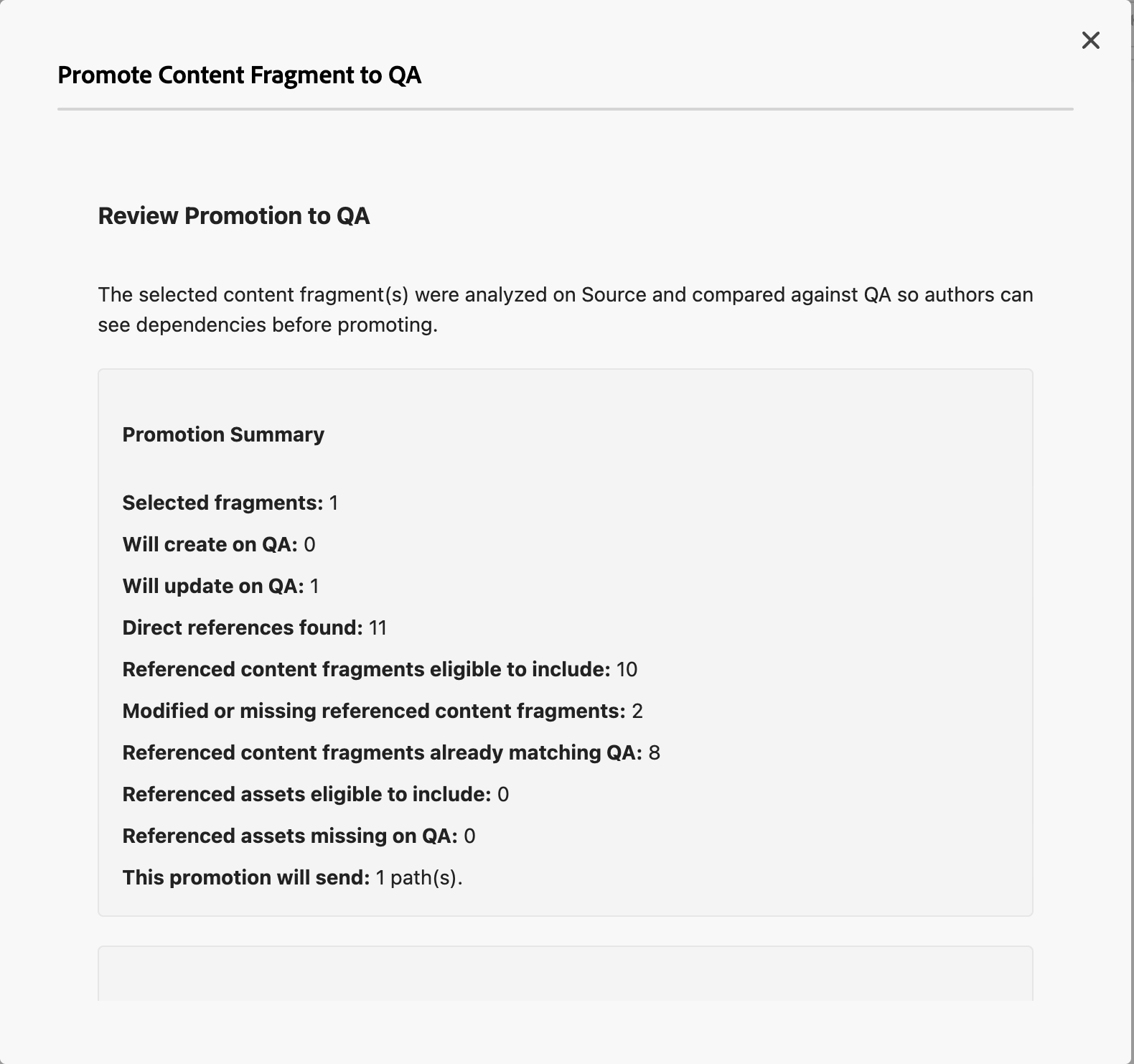
Authors can see what will be created, what will be updated, and which direct references are involved. Instead of guessing or relying on external documentation, they can make informed decisions in the moment.
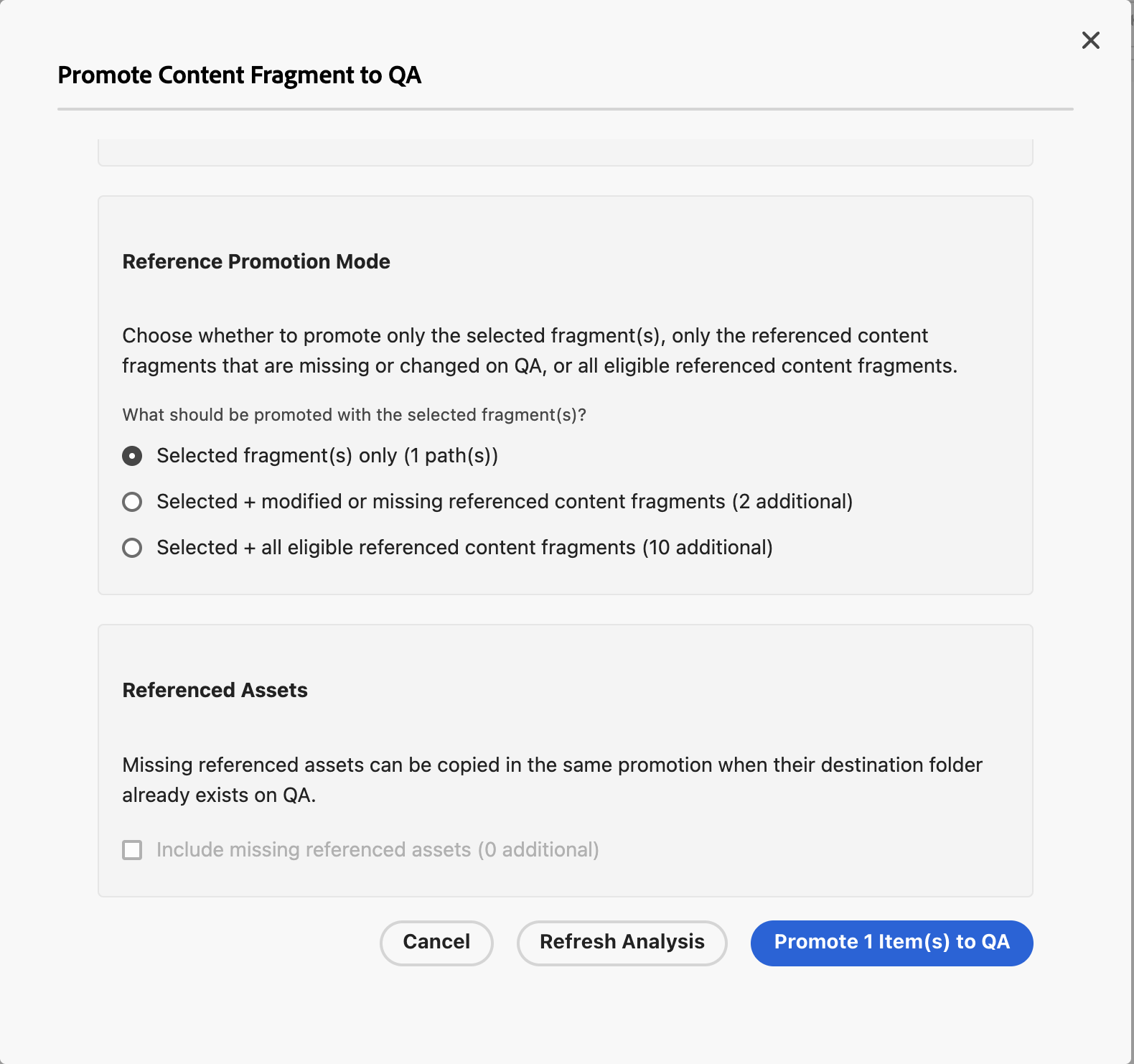
Dependency handling is also built into the experience. Authors can choose to promote only the selected fragment, include referenced Content Fragments that are missing or changed, or include all eligible references. When the target structure allows, they can also include missing referenced assets.
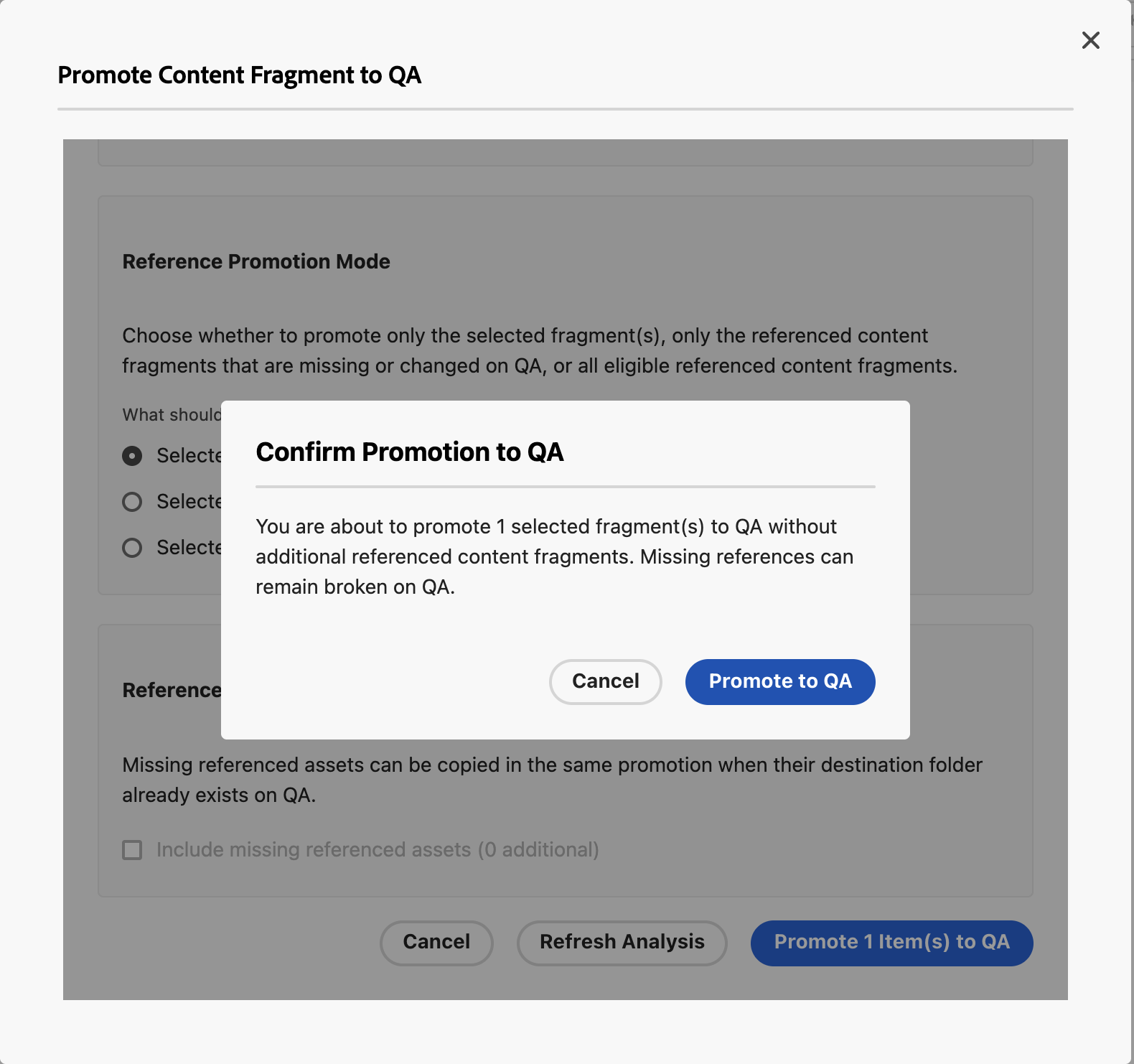
A confirmation step reinforces control. It highlights risks, especially when dependencies are excluded, and ensures that promotions are intentional and complete.
In practice, this shifts promotion from a fragmented, multi-step process into a single, guided action within AEM.
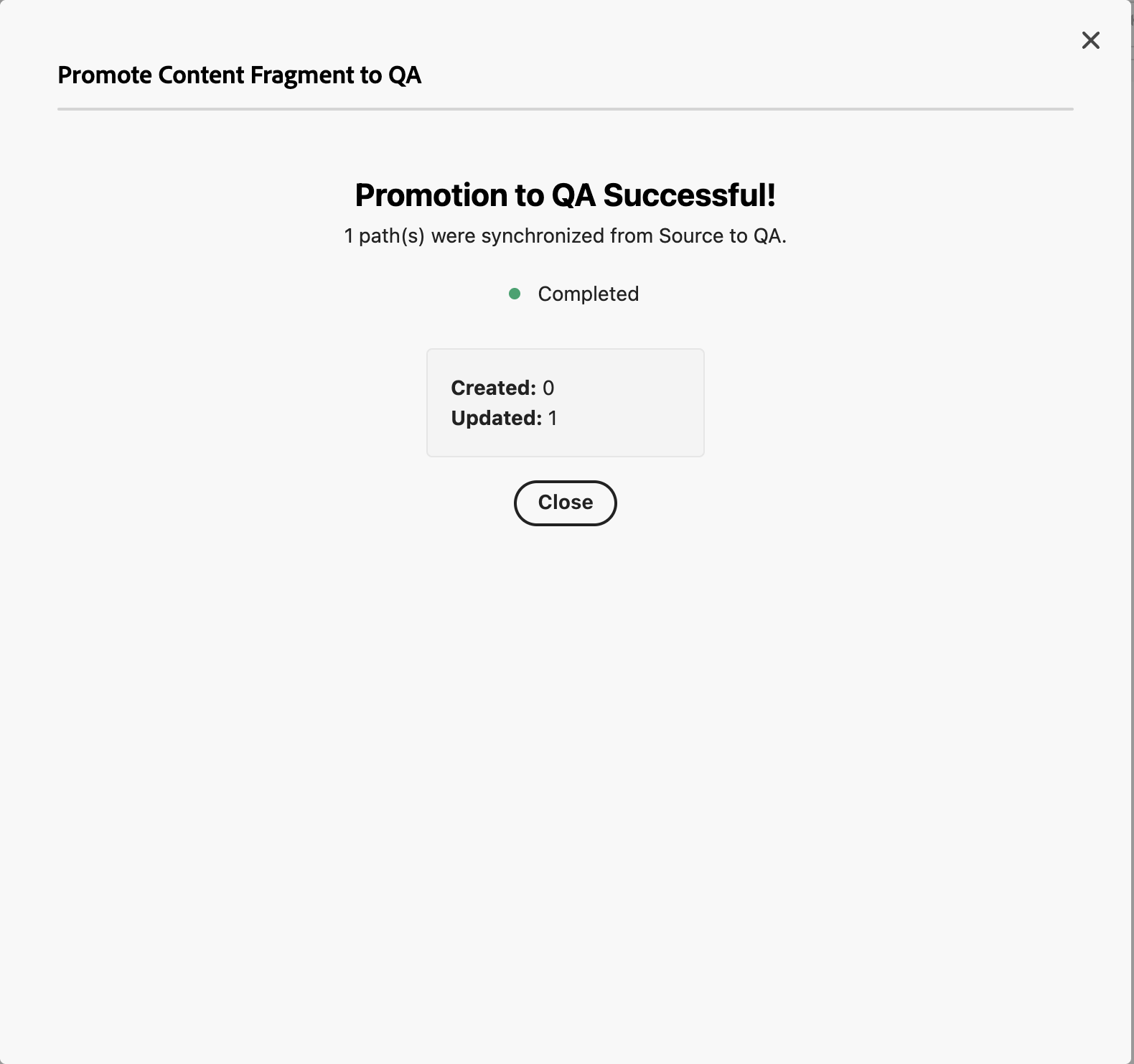
A Workflow Fix with Operating Model Impact
This type of extension solves a usability problem and addresses a broader operating model challenge. Authors get a reliable, self-service workflow that maintains momentum. Developers handle fewer repetitive requests that don’t require technical expertise. QA teams are removed from the unnecessary handoffs tied to environment-to-environment content movement. For architects and platform owners, it represents a more sustainable pattern, with the workflow becoming a part of the product itself, which is visible, governed, and repeatable.
This shift also supports a more mature approach to staged approvals. When stakeholders review content in staging, the final step into production no longer depends on manual coordination. It becomes a natural extension of the authoring lifecycle. More broadly, this reflects a move toward productizing internal workflows. Teams are solving isolated friction points and building systems that scale with the organization. They reduce operational overhead and align with how modern digital platforms are expected to function.
If content promotion still depends on tickets, scripts, or informal handoffs, it’s often a sign that the workflow needs to evolve.
A guided, in-context promotion experience helps teams move faster, reduce coordination overhead, and increase confidence in release readiness. More importantly, it also creates a foundation that can support growth rather than constrain it.
If this challenge sounds familiar, it’s because it’s common. Bounteous has seen it across AEM programs and recognizes the opportunity to turn it into a more durable, author-centered solution.
News & Insights
Featured Perspectives