When Personalization Fails Silently and What We Built to Fix It
Most personalization failures do not announce themselves. There is no error alert, no broken page, no red warning in the dashboard. Instead, a test runs for a week, produces flat results, and nobody knows why. The merchandising team looks at the numbers, shrugs, and moves on to the next campaign, with the underlying problem still silently undermining every subsequent test.
That is the exact situation a Digital Personalization Manager at a leading U.S. retailer described when our team sat down with her. Bloomreach Search 1:1 personalization was configured and running. It just wasn't working. And there was no diagnostic layer to tell her why.
"We ran a test for about a week and didn't see any positive traction. Most of our customers aren't logging in when they come to the site."
- Digital Personalisation Manager, leading US retailer
This year, Bloomreach ran the Loomi Connect AI Hackathon, a global competition for implementation partners built around its MCP platform. In direct partnership with a leading U.S. retailer, Bounteous entered the competition, grounding our submission in a documented, real-world challenge. The result was the Personalization Performance Doctor, an AI diagnostic agent that gives merchandising teams the visibility they have always lacked.
The solution brought together eight diagnostic dimensions, three Bloomreach data sources, and a human-in-the-loop design that requires practitioner approval before any change reaches production.
8
PRS Dimensions
3
MCP Surfaces Consumed
0
Auto-Writes — Human in the Loop
The Problem That Hides in Plain Sight
Personalization at scale is a configuration problem as much as it is a technology problem. Platforms like Bloomreach Search expose powerful capabilities, including 1:1 personalization, audience segmentation, boost and bury rules, and A/B testing. But the gap between "configured" and "working" is surprisingly wide, and the signals that explain that gap are scattered across multiple surfaces.
In this case, when personalization underperformed, the root causes were not visible from the front end. Seventy-eight percent of sessions could not identify returning visitors. Without consistent identity, AutoSegments were sparse, profile completeness was low, and behavioral signal richness was insufficient to drive meaningful segment definitions.
Boost rules existed but pointed at audiences that barely populated. And without measurement, there was no way to know if the configuration was improving or deteriorating over time.
These are the most common reasons personalization fails to deliver, and they are invisible without a purpose-built diagnostic layer.
Building the Personalization Performance Doctor
The Personalization Performance Doctor is an AI diagnostic agent built on the Bloomreach Loomi Connect MCP platform. It does three things that merchandising teams cannot currently do on their own. It scores personalization health, explains root causes in plain English, and tells practitioners exactly what to fix first, ranked by estimated revenue impact.
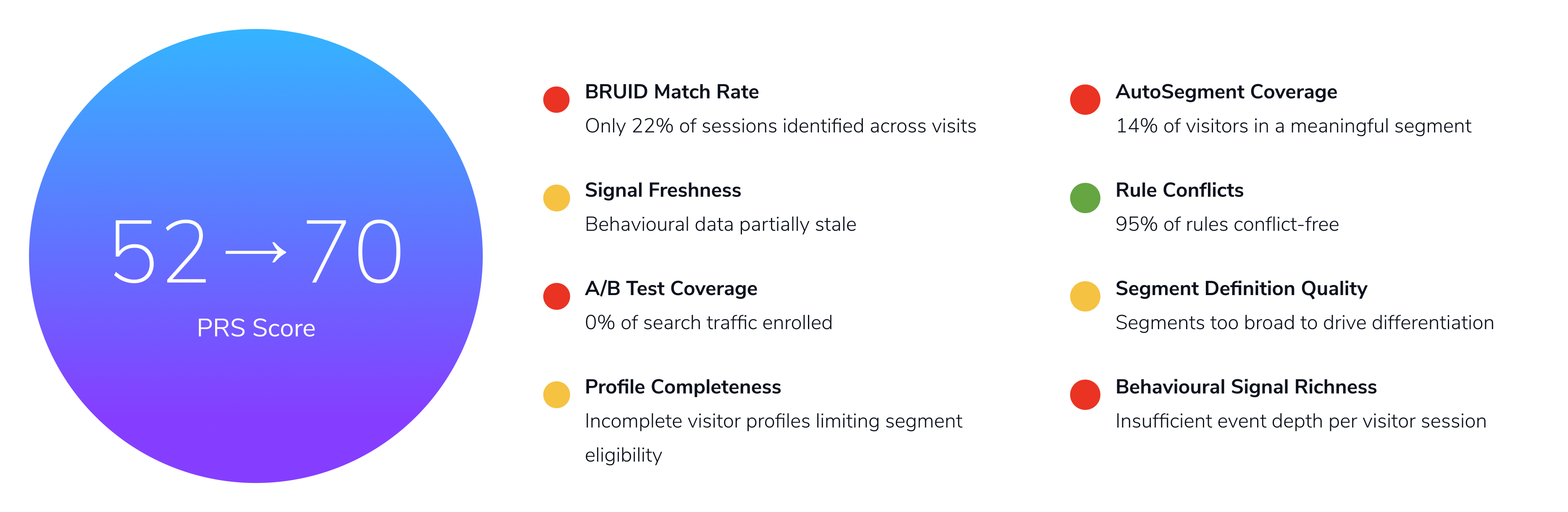
The Personalization Readiness Score (PRS) aggregates eight diagnostic dimensions into a single 0–100 composite: BRUID Match Rate, AutoSegment Coverage, Signal Freshness, Rule Conflicts, A/B Test Coverage, Segment Definition Quality, Profile Completeness, and Behavioral Signal Richness. Each dimension draws from a different data source. BRUID match rate and rule conflicts come from the Search REST API; AutoSegment coverage, signal freshness, profile completeness, and behavioral signal richness come from the Loomi Marketing MCP; and A/B test coverage and segment definition quality come from the Loomi Analytics MCP.
These dimensions combine to give the agent a more complete view of personalization health than any single dashboard can provide. When a practitioner asks a question, the agent draws on the relevant signals, identifies likely root causes, and explains the recommendation step by step.
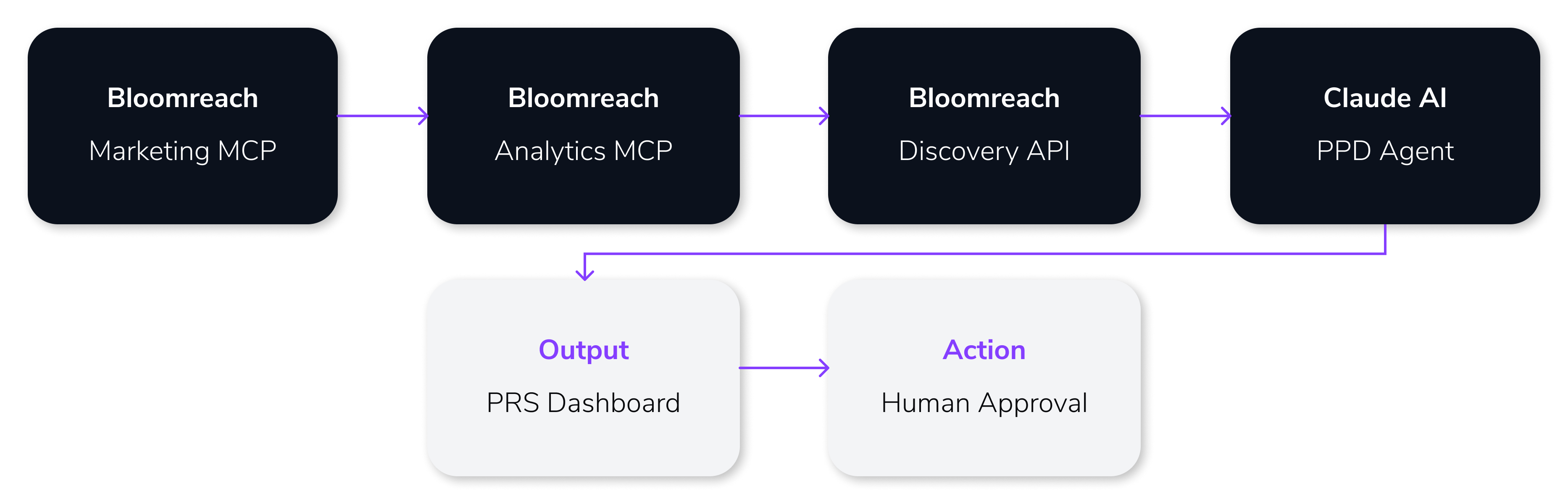
At a high level, the architecture connects Bloomreach data sources with a Claude-powered PPD agent and a PRS dashboard that merchandising teams can use to diagnose personalization performance.
The architecture is intentionally simple on the surface and sophisticated underneath. An integration layer normalizes data from all three Bloomreach sources into a common schema. A deterministic scoring engine applies linear interpolation across all eight dimensions to produce the PRS. The Claude AI agent sits alongside the scoring pipeline and receives practitioner questions, selects which data tools to call at runtime using Claude's native tool use API, and synthesizes the results into ranked recommendations.
The Agent Recommends and the Human Decides
Every recommendation from the Personalization Performance Doctor requires explicit human approval before any change reaches the live environment. The approval records intent in the application state, surfaces a confirmation, and leaves the practitioner to activate changes manually in the Bloomreach Discovery console. This is a deliberate design decision that keeps the merchandiser accountable and in control.
What Agentic AI Actually Means for Commerce Teams
There is a meaningful difference between automation and agentic reasoning. Automation executes a fixed sequence of steps. An AI agent explores the problem space, selects the right tools based on context, and produces reasoning that practitioners can interrogate and act on.
When a practitioner asks, "Why is my personalization not working?", the PPD agent does not run a script. It evaluates the question, determines which of eight data fetchers are relevant, queries the live MCP tools, reads the results, and constructs a ranked diagnosis with supporting evidence, all visible as a live reasoning trace in the interface. The practitioner sees the entire chain of decisions that produced it.
This matters because trust in AI-assisted decision-making is built through transparency, not accuracy alone. A recommendation without an explanation is a black box. A recommendation with a visible reasoning chain is a colleague showing their work.
From Hackathon to Production Reality
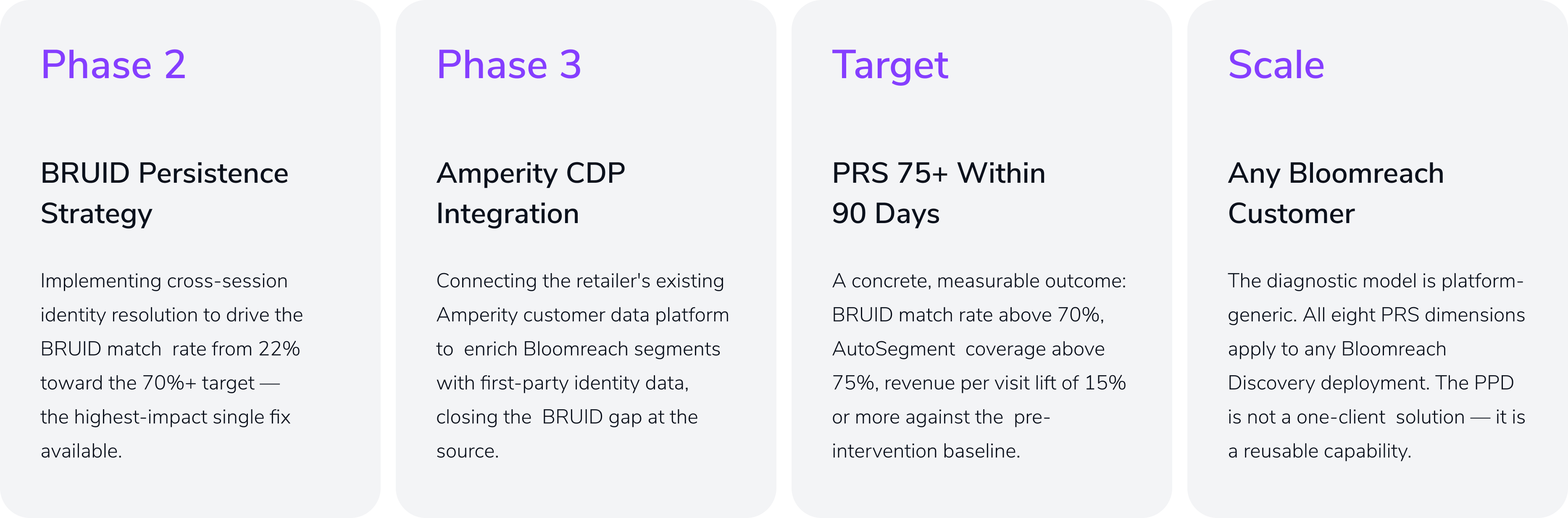
The Personalization Performance Doctor was built as a hackathon submission, but its value does not stop at the competition boundary. Every Bloomreach customer with 1:1 personalization configured already has a PRS, they just do not have the tooling to surface those signals, interpret them, and connect them to specific actions.
What This Tells Us About Where AI Is Heading in Commerce
The most valuable AI applications in ecommerce strengthen human decision-making by removing the blind spots that prevent teams from seeing what is actually affecting performance.
"We're seeing the strongest agency partners rethink how they work, building AI into their core delivery model rather than layering it on top. Bounteous is a good example of that shift. Through the Loomi Connect AI Hackathon, their team built a diagnostic experience that shows how Bloomreach's agentic AI capabilities can surface hidden performance gaps and give commerce teams the confidence to act on them. That's what we're building toward with all of our partners, and it's exciting to see it take shape."
- Anirban Bardalaye, Bloomreach Chief Product Officer
Our clients are experts at personalization. What they lacked was visibility into why the platform was performing differently than expected. The Personalization Performance Doctor gives them that visibility in a simple, conversational way they can query as needed, surfacing root causes on demand and keeping them in control of every action taken.
This is the design pattern that scales. Any time a business question requires context from more than one data surface, and any time the gap between a failing KPI and its root cause is invisible from the front end, an agentic diagnostic layer creates value. Bloomreach's Loomi Connect MCP platform makes that pattern achievable for implementation partners with the technical depth to connect AI capability to a genuine client problem.
What began as a hackathon submission is now a working diagnostic concept tied to a documented business pain point, with a clear roadmap for driving measurable revenue impact.
That is where AI implementation becomes impactful, when it gives teams better visibility, clearer decisions, and a practical path to performance improvement.
News & Insights
Featured Perspectives