Automating GA4 and GTM Governance with APIs
Enterprise analytics environments that look healthy on the surface often fail at the governance layer underneath.
In large organizations, it's common to find hundreds of Google Analytics 4 (GA4) properties and dozens of Google Tag Manager (GTM) containers with inconsistent naming conventions, manual access reviews, no reliable property inventory, and no scalable way to validate implementation health.
Most governance processes still rely on someone clicking through the Admin UI to "check things." That might work when you have five properties. It starts breaking at fifty. At one hundred, it becomes unsustainable.
If your enterprise governance model depends on manual navigation, it can only support spot checks. It cannot become the foundation for scalable, ongoing governance.
Where Manual GA4 and GTM Review Breaks Down
The GA4 and GTM interfaces are powerful for configuration. Enterprise inventory management is a different problem entirely.
At scale, teams find no single export of all accounts and properties, no consolidated view of user access across environments, no clean way to reconcile GA4 properties with GTM containers, and no repeatable method for detecting configuration drift.
Over time, the gap between what exists and what is documented gets wider. That gap turns into risk as manual processes struggle to keep up with growth and undocumented changes compound quietly.
Automation is the better answer to this problem. Having a dedicated spreadsheet may create temporary visibility, but enterprise teams need a repeatable way to collect, reconcile, and monitor governance data as environments change.
The Shift to API-Driven Governance
In a recent internal training session, we walked through a lightweight automation framework designed to create structured visibility across GA4 and GTM environments.
The approach leveraged the Google Analytics Admin API, the Google Tag Manager API, Apps Script as an orchestration layer, and Google Sheets as a structured reporting surface.
At a high level, the workflow pulls all GA4 accounts accessible to the organization, retrieves properties under targeted accounts using naming filters, extracts GTM container inventories, reconciles GA4 measurement IDs with GTM configurations, and exports and documents user access across properties.
Instead of asking "What do we have?" and manually checking, teams can answer that question programmatically in seconds.
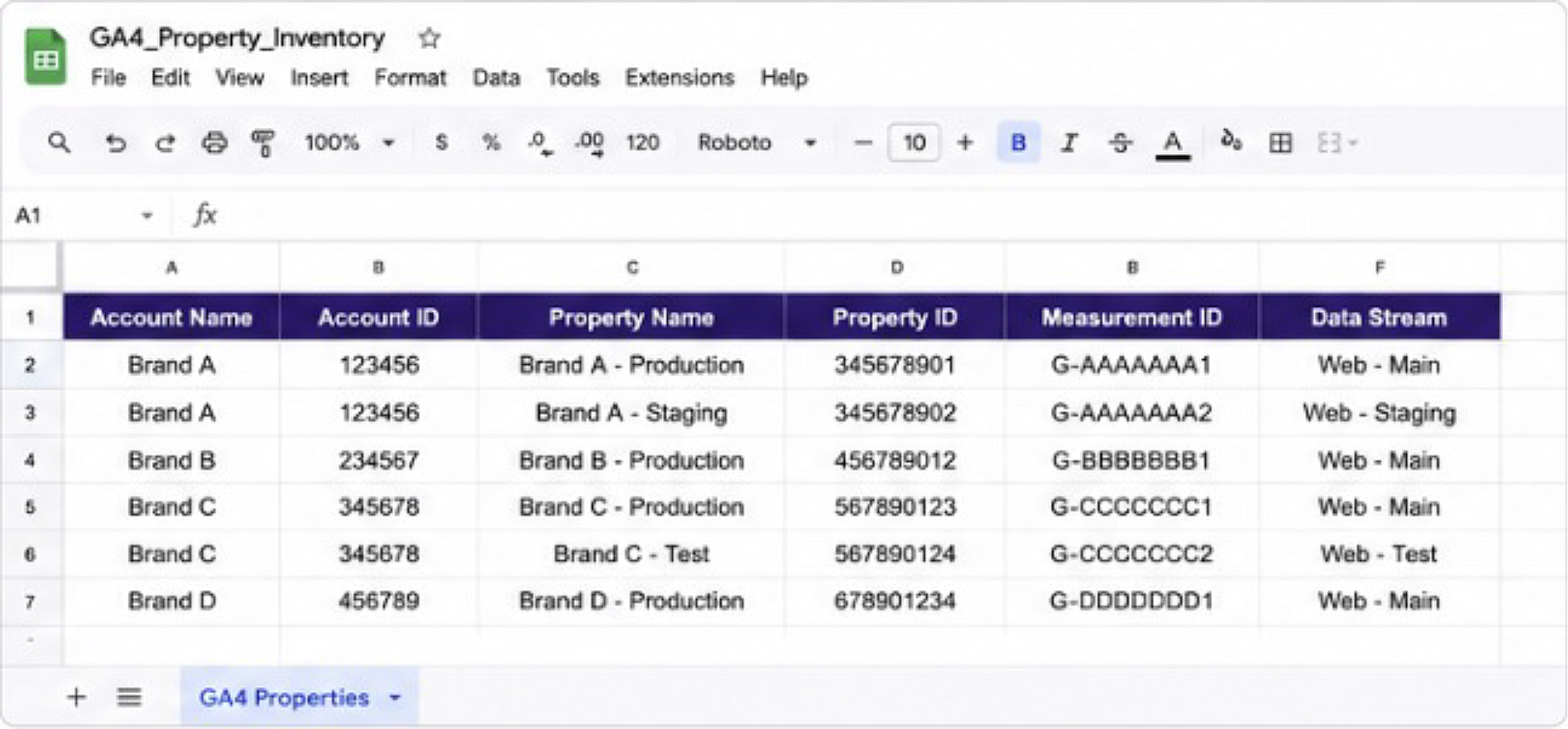
This moves governance away from one-off manual checks and toward a repeatable, system-driven operating model.
A Practical Example of Structured Filtering at Scale
In enterprise environments, not every account should be audited at once. Governance requires structure and prioritization, especially when different business units, markets, or teams manage their own GA4 properties and GTM containers.
That prioritization can be built into the audit process. By layering business rules on top of API calls, teams can target specific business units using naming conventions, generate structured property inventories, build reconciliation views between GA4 and GTM, and export access matrices for audit and compliance purposes.
Even a simple API call becomes more useful when it is wrapped in logic that reflects how the organization actually operates.
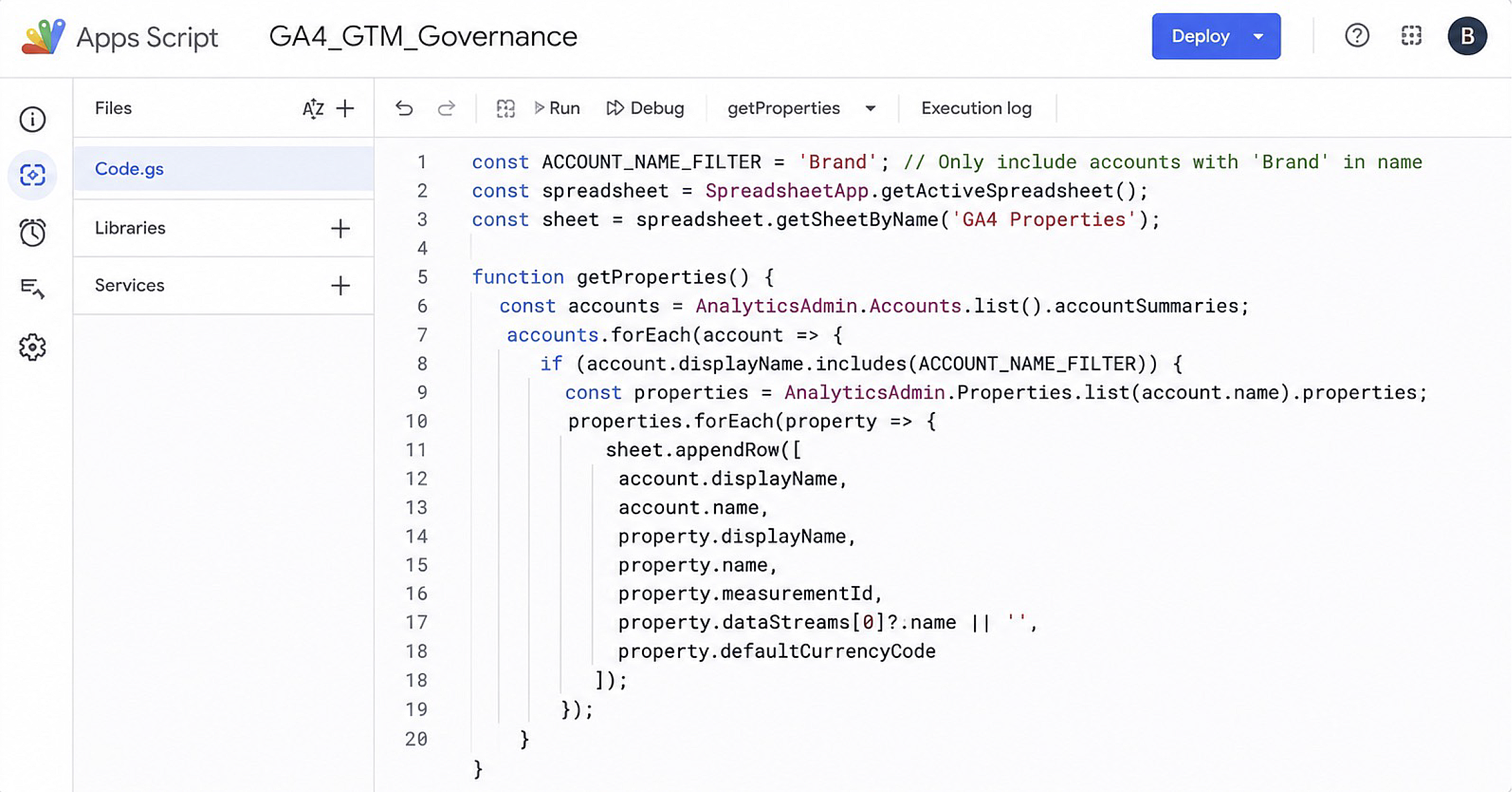
The UI is still where configuration happens. The goal is to elevate governance beyond manual inspection and create confidence at scale.
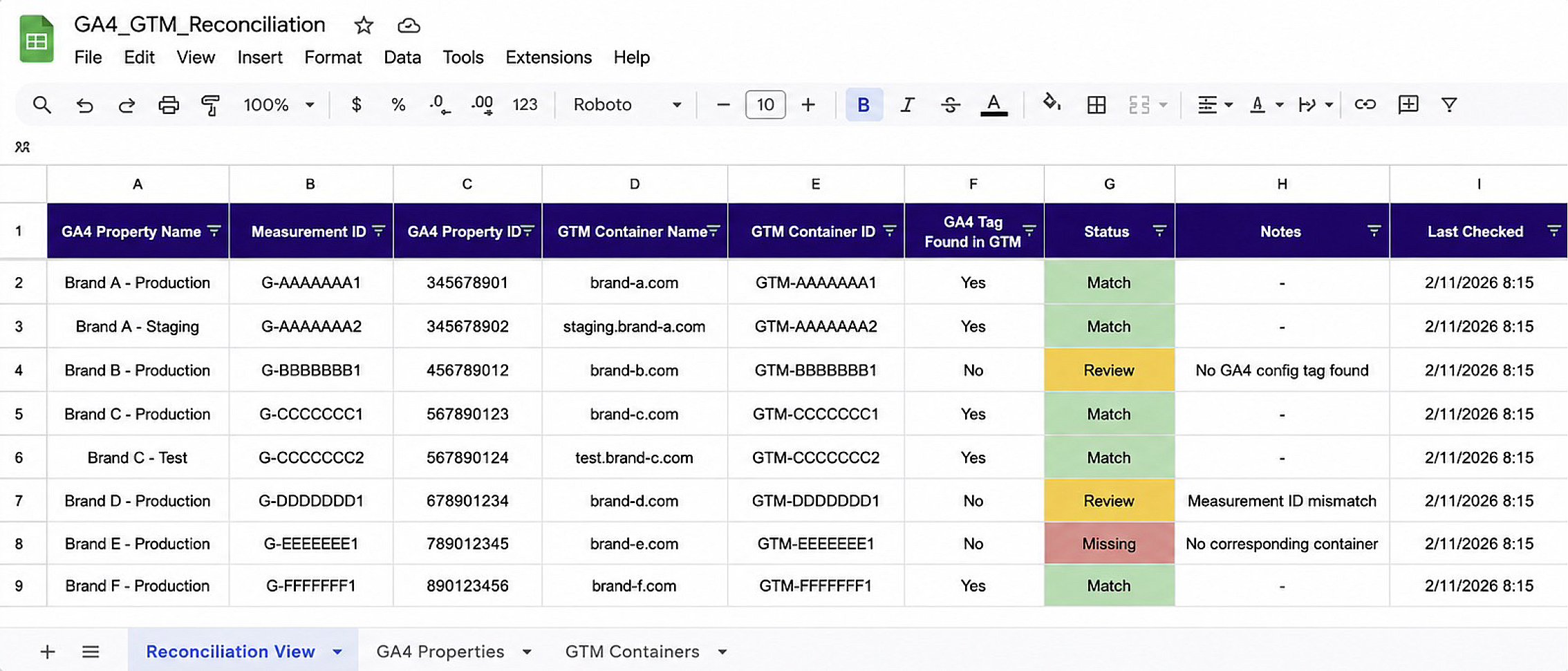
Why Governance Matters More as Analytics Becomes More AI-Driven
As organizations expand into AI-driven modeling, attribution refinement, and advanced traffic classification, the cost of uncertainty increases. AI models are only as reliable as the analytics environment they are built on.
API-driven governance enables automated inventory validation, early detection of configuration drift, scalable access audits, reliable documentation of properties and streams, and validation layers before modeling begins.
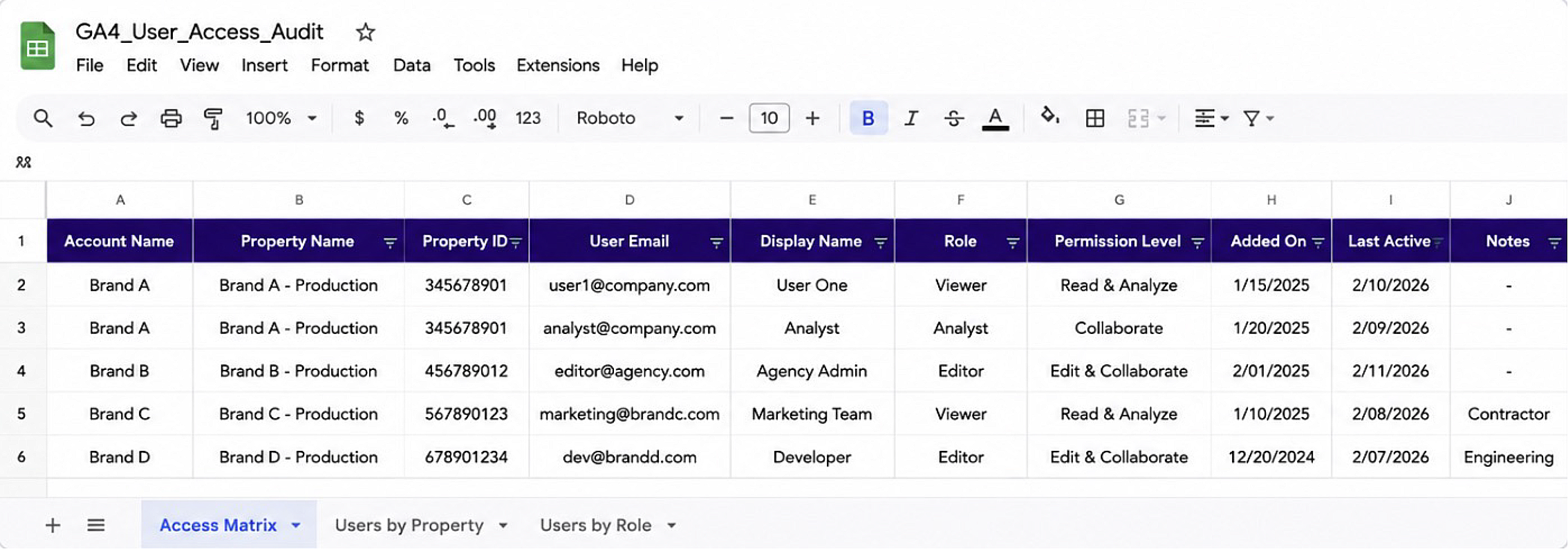
Before layering AI onto your analytics stack, you need stability underneath it. Automation helps create that foundation.
From Tactical Automation to Enterprise Monitoring
Google Apps Script is an accessible starting point. It allows teams to prove the concept quickly and create immediate visibility.
Those same principles can then evolve into more robust architecture, with governance workflows deployed through Cloud Run, recurring audits scheduled automatically, configuration data written into Google BigQuery, and alerts triggered when environments change.
As the architecture matures, governance stops being a quarterly exercise and becomes part of a continuous operating model. Enterprise analytics maturity is increasingly defined by the strength of the systems behind the dashboards. For that model to work, governance needs to be inventory-driven and API-accessible. Manual review cannot scale or build the confidence enterprise analytics programs need.
Bounteous helps enterprise teams design API-driven governance frameworks that create centralized visibility, automate access validation, reconcile GA4 and GTM configurations, and establish scalable controls before AI modeling begins.
At scale, governance is about building systems that create visibility, surface risk, and support better decisions before issues become harder to fix.
News & Insights
Featured Perspectives